How a resin table is made: one hundred and twenty hours.
Search for how a resin table is made and you will find weekend projects: a mould, a few buckets, a sander. That is a real way to make a table. It is not how ours is made, and the difference is where the time goes. This is the route a piece takes through the atelier in Dubai, stage by stage.
Most of the time is spent before the resin is opened.
Each of our tables takes about one hundred and twenty hours of hand work. People sometimes picture that time going into the pour, as if the resin were the craft. It is the shortest part. The hours sit on either side of it: in the drawing, the drilling and the threading before, and in the polishing and tuning after.
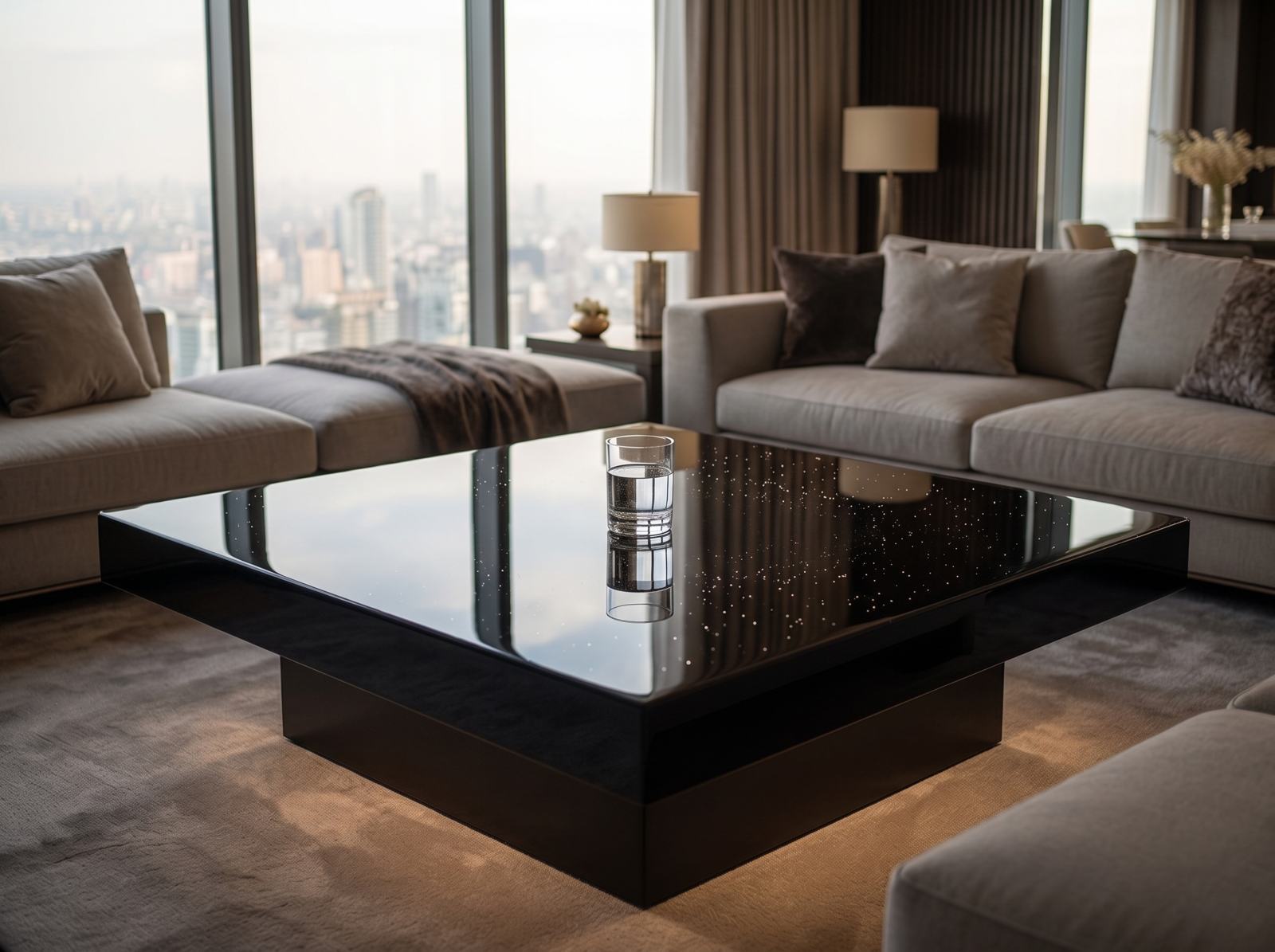
The route below follows Nebula, our signature piece, because it uses every stage: seven hundred fibre-optic stars in three magnitudes under black resin, and a sensing layer with thirty-six touch zones that answers to a glass or a palm. A plain resin table skips several of these steps. A light-carrying one cannot.
Nothing here is secret, and none of it is quick. That is the honest answer to why a handmade table takes from four weeks and why it costs what it does.
Six stages, in order.
On the home page we describe four: mapped, poured, polished, awakened. Opened up, the first two each hold a second stage inside them.
i. Drawn
Every sky starts as its own star chart. Stars are placed in three magnitudes, so that bright ones and faint ones sit at different weights, as they do overhead. For a commission the drawing might be the sky over a city on one particular night, an emblem or a line of calligraphy. The composition is drawn at full size and agreed with the client before anything is cut, so the table approved on paper is the table that is built.
ii. Drilled
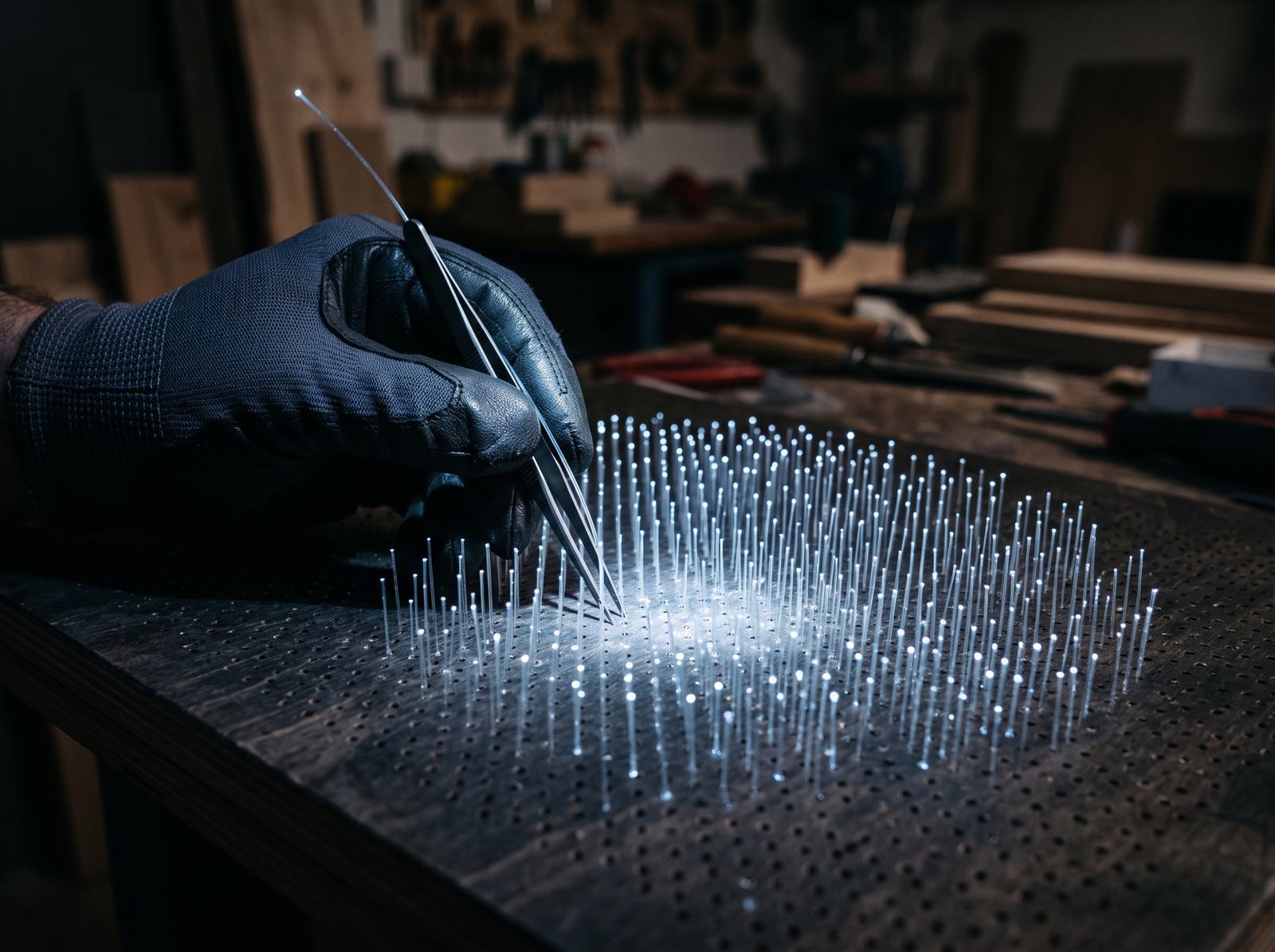
The chart is transferred to the top and drilled — on Nebula, seven hundred points in three sizes. A hole that wanders is a star in the wrong place, and once the resin is poured it cannot be moved. This is slow, repetitive work, and it is where a hurried piece shows first: in a sky that looks scattered rather than drawn.
iii. Threaded
A single optical fibre goes into every point, by hand. Seven hundred fibres, each seated, held and routed underneath so it carries light from the source to its own star. The fibre does not glow along its length; it carries light to its tip. That is why the points stay sharp, and why a fibre-optic table looks so different from an LED table that washes the whole surface with colour.
iv. Poured
The threaded top is held in a single slow pour of black resin. Slow matters: epoxy gives off heat as it cures, and a deep pour that runs too hot can cloud, crack or discolour. We wrote about that separately in why cheap epoxy tables turn yellow. After the pour, the table waits. Nothing useful can be done to it until the resin has fully cured.
v. Polished
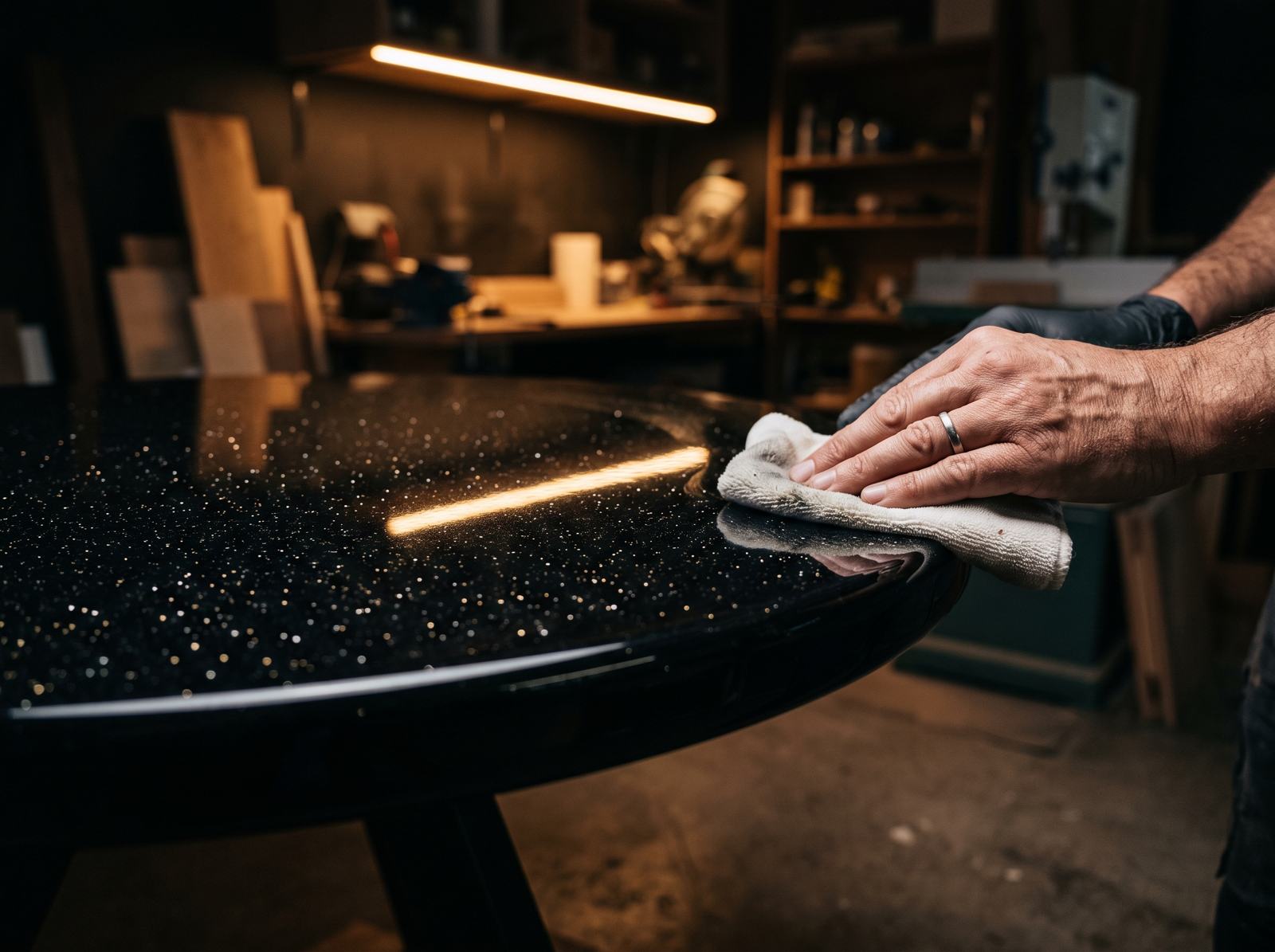
The cured surface goes through ten grades of abrasive and two polishing compounds, each one removing the marks of the one before, until the black reads as a mirror. The fibre ends are polished along with it. Skip a grade and the scratches it should have removed stay visible under a lamp.
vi. Awakened
Last comes the sensing layer. It is tuned zone by zone — thirty-six of them on Nebula — so that a glass set down on the surface draws a ring of light where it stands, and nowhere else. Then the finished table runs for a full night in the atelier before it is allowed to leave.
The same materials, a different job.
The step-by-step guides that fill the first page of search results describe a sound method for a river table: flatten the wood, build a mould, pour, wait, sand, finish. Those steps are all real, and they are the reason a resin table can be made at home.
What they do not need is a chart, seven hundred holes, seven hundred fibres or a sensing layer. Those are the stages that make the hours. They are also the stages that cannot be fixed afterwards: a misplaced star, a fibre that breaks under the resin or a zone that does not answer is sealed into the table for good. So each stage has to be right before the next one closes over it.
The night of running before delivery is the last of those checks. It is there to catch what an hour on the bench would not.
What the hours mean for you.
The process sets the practical terms of an order more than anything we could write in a price list.
Why from four weeks?
Because the stages run in sequence and the pour sets its own pace. The drawing must be agreed before the drilling, and the resin must cure before the polishing. Four weeks is where an order starts; the delivery date for your piece comes with the drawing proposal.
Can the sky be my own?
Yes. The drawing stage is where a commission happens: your dimensions, your emblem, your constellation — the sky on the night that mattered. Bespoke sizes run up to 3.6 metres.
Why an edition of twenty-five?
Each design is made as an edition of twenty-five numbered pieces. Every one of them goes through the same six stages, by hand, in the same atelier.
What happens after the last night?
The table is delivered and installed. Delivery within the UAE is included, with installation, and we ship to Saudi Arabia, Qatar, Kuwait, Bahrain and Oman. Every piece is made to order, so it is not returnable — one more reason we agree the drawing before we start.
Four pieces, each made this way
Every table is made to order in our Dubai atelier. Nebula carries the full sequence above; the other three change the drawing and the pour — two walnut slabs and a river of clear resin, six poured layers of sand and surf, a backgammon board in walnut and brass.
- Nebula
- Black resin · 700 stars · from AED 11,000
- Rivière
- Walnut and clear resin · from AED 9,000
- Océan
- Six poured layers · from AED 8,500
- Tawla
- Backgammon in walnut, brass, resin · from AED 7,500
- Nebula size
- 800 × 800 × 400 mm
- Lead time
- From 4 weeks
- UAE delivery
- Included, with installation
- Returns
- Made to order, not returnable